join us    |   sign in    |   contact us

Author: Michelle Mellon

NRWC Employer Engagement Specialist Certification Open for Enrollment

We are pleased to announce that the NRWC Employer Engagement Specialist Certification program has launched!

Recognizing the shifting landscape affecting reentry workforce programs and opportunities for justice-impacted job seekers, this certification focuses on best practices to help professionals in one area where they can have consistent impact—how they engage with employers. It also includes four original frameworks as well as, templates, guides, and other resources  to support learning throughout the program with real-life applicability beyond the course.

We are grateful for the input from our community to help us design this certification, assistance from community members to test the pilot, and the generosity of the T.D. Jakes Foundation in supporting program enrollment.

To learn more about how you can become an NRWC-certified Employer Engagement Specialist, visit the certification program page.

Why Employer Engagement is the Keystone of Reentry Work

If you’ve been feeling the ground shift under your program recently, you’re not alone. The labor market is in persistent flux, which means what you’re experiencing probably doesn’t even look the same as it did last quarter. For reentry workforce professionals, this volatility means a change in thinking about what the recruitment-to-hire process looks like.

Navigating a hard-to-read job market

Economists call the current environment “low-fire, low-hire.” Instead of mass layoffs or rapid replacements, many employers are being more deliberate in their retention and recruitment efforts. For the latter, that often translates to longer application-to-hire cycles.

This kind of caution is arguably harder for job seekers to work with than a downturn, because there’s no clear signal telling them what to do differently. The need (and thus the timeline for recruitment) also varies wildly across professions. It would seem the current advantage lies with employers.

However, the LinkedIn Talent Research 2026 highlights how job openings have roughly doubled since 2022, yet employers report unprecedented difficulty filling positions. According to National University’s 2026 hiring statistics analysis, 53% of employers say verifying skills is their main obstacle. That’s a symptom of another shift, away from a focus on degrees, titles, and accolades to prioritizing versatility and adaptable experiences.

Giving employers what they’re looking for

Among employers surveyed by the National Association of Colleges and Employers for its 2026 Job Outlook, 70% report using skills-based hiring. That’s up from 65% the year before. And 71% of those employers use a skills-forward approach at least half the time. 

That’s a favorable opening for justice-impacted job seekers, whose transferable skills, work history, and lived competencies may not have read as easily on a traditional resume. Even as employers cite skilled-labor shortages, retention challenges, and a widening mismatch between the roles they need filled and the workers available to fill them, there’s a talent pool waiting to be (re)discovered. 

And discovery is largely about positioning. Many employers are investing in upskilling, building longer-term pipelines rather than one-off postings, and prioritizing clear, consistent communication with candidates and staffing partners. Those are behaviors rooted in, and impossible without, sound relationship-building.

The AI question everyone is wrestling with

Yet no conversation about the nature of work in 2026 can exclude AI. Globally, 40% of workers now fear that AI will make their job obsolete, up from 28% just two years ago and in the U.S., that concern runs even higher (Mercer Global Talent Trends 2026 survey). 

Much like the market in general, however, the only AI constant is inconsistency. The Economist recently touted an “AI jobs boom,” even as hiring lulls are attributed in large part to AI uncertainty. The Wall Street Journal reported a hot job market for workers without college degrees, even as experts predict AI will nullify many non-degree roles in office environments.

For reentry professionals, this matters in two ways. First, it means the repetitive or task-heavy roles that have historically been common entry points for justice-impacted job seekers may shift in scope or number over time. This underscores the need to build relationships with employers across a wider range of sectors and skill levels. 

Second, it means employers themselves may be as anxious and uncertain as job seekers about what’s next. This can make employers more receptive, not less, to workforce partners who can bring clarity with vetted, supported candidates who reduce onboarding risk by meeting current as well as perceived future needs. 

Stronger employer relationships are imperative

None of this— selective caution, skills-based hiring, AI disruption— resolves itself through a stronger resume or a better interview coaching session alone. Instead, it’s about employers who trust that you understand their big-picture priorities, can bring candidates ready, willing, and able to help boost their company’s bottom line, and are committed to successful placements defined by sustainability for both employer and employee.

That’s why employer engagement should be viewed as a core professional skill for reentry workforce. In its two-day FutureWorks conference earlier this month, Indeed.com showcased hiring managers and employers who, despite the potential inherent in AI, uniformly lauded “the human advantage.” 

How does that look? It’s personal and relatable. It’s cultivating regular contact and open conversations. It’s recognizing how stronger employer relationships expand what your program can offer: more openings, more flexibility, more willingness on the part of employers to actively partner with you, rely on you, trust you as a valued member of their team.

The opportunities in the future of work lie in the gap between quantity and quality—the fine-for-now versus the long-term right fit. Knowing how to seize those opportunities to engage and encourage employers is a significant part of your role as a broker of trust. Instead of trying to keep pace, you can work with employers to set a pace that works for them and for justice-impacted job seekers so that together you’re helping meet needs now and well into the future.

NRWC conducts onsite Employer Engagement Training sessions and is now launching an Employer Engagement Specialist Certification. 

Future of Work: Career Durability in a Changing Labor Market

At the height of the COVID-19 pandemic, experts asserted that change is the new normal. While some people embraced the idea of persistent novelty, others wished for things to “go back” to how they were. 

There’s an old saying: “The more things change, the more they stay the same.” Does this idea still hold up if “the same” now equals constant change, and at an accelerated rate? In fact, how can anything remain, when it seems like everything is in flux? 

The point of this saying is to focus on what’s at the core of the transformation. Shifting titles, labels, and categories are simply means to an end—the fundamentals behind them don’t change. For justice-impacted workers, that unchanging core goal is economic mobility. So how do you leverage change to achieve it?

Martec’s Law

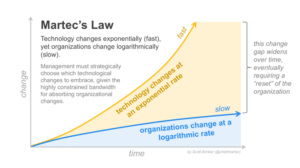
Normally when we think about change we envision infinite possibilities. Yet there are limits based on who or what is experiencing change. As Martec’s Law notes: Technology changes exponentially; organizations change logarithmically. 

Often technology is developed well before its potential use cases are mapped out. AI is a prime example of that, as it continually evolves and acquires new capabilities while individuals, employers, social standards, and legislation struggle to keep pace.

What does that mean for the reentry workforce field? For the most part, it means learning how to strategically weather disruption. We’ve seen wave after wave of labor market changes attributed to AI, yet some organizations have already begun reversing previous decisions and are re-hiring human labor.

The back-and-forth highlights the gap noted in Martec’s Law; the opportunities that exist in the uncertainty between where organizations are and where they could be. To ensure that justice-impacted job seekers are employable now and adaptable to advance with change, it helps to recognize and plan for the long-term possibilities.

Reexamining Need and Reallocating Labor

The challenge for modern job seekers isn’t a shortage of jobs; it’s a mismatch between where workers are and where the opportunities have moved. AI and automation may be eliminating routine task roles, but not roles requiring creativity, mental agility, and an indisputable human touch, like the skilled trades. For justice-impacted job seekers, this shift offers an opening if they can show employers they possess the desired skill set. 

That too, is changing for the better. Job search platforms consistently report that employers are focusing less on candidates who can learn a specific process and more on candidates who can adapt quickly once they’re in the role. That means transferable “soft” skills that shorten the learning curve—leadership, communication and active listening, critical thinking and problem-solving, emotional intelligence, teamwork—are becoming the real currency of long-term employability.

In a LinkedIn survey, 90% of employers reported these so-called soft skills (more popularly referred to now as essential or power skills) to be as important as technical skills. Yet most of those same leaders reported difficulty finding hires who meet that need. Many of these skills are not easily learned through training; they’re inherent or accumulated across a variety of experiences. 

The task ahead for the reentry workforce field is to not only match job seekers based on interest, experience, and learned skills, but to translate a justice-impacted individual’s lived experience into language employers recognize as valuable. Sustainable employment with opportunities for advancement comes through connecting the full range of your job seeker’s capabilities to a labor market that’s reallocating talent to meet the quickly evolving needs of the future of work.

We invite you to view the recording our webinar: “Future of Work” Career Durability in a Changing Labor Market where you’ll hear from experts on how you can prepare justice-impacted individuals to productively navigate uncertainty for career durability and advancement.

Resources Shared by Our Speakers

Continue exploring the topics discussed during the webinar with these resources shared by our panelists.

Dean Craig – Business Services Director, Willamette Workforce Partnership

Kysha Wright Frazier – President & CEO, Corporation for a Skilled Workforce

Audrey Mickahail – SVP, Market Strategy & Solutions, Opportunity@Work

hand holding a small American flag against a dark sky lit up by fireworks

250 Years & Counting: A Legacy of Innovation, A Future Built Together

As the U.S. celebrates its 250th anniversary this month, much of the national conversation has focused on the nation’s past, present, and future. Throughout our history, progress has often come from people who saw problems as opportunities to innovate. That pioneering spirit is woven into the fabric of our country. America has long been a nation of innovation, with each idea and advance driven by the pursuit of greater opportunity and the freedom to thrive.

The ultimate goal of the reentry workforce field is no different. From frontline practice to shaping policy, we are working to address challenges and remove barriers to employment so that justice-impacted individuals have the economic mobility (and the freedom) to thrive.

Community-Based Innovation

The gap between where justice-impacted job seekers currently are (with an unemployment rate of around 30% and more than 40,000 collateral and systemic barriers to overcome) and where they should be (building sustainable careers that provide financial security and upward mobility) might appear overwhelming. Until you begin to see it as an opportunity for innovation.

That’s exactly what most community-based organizations (CBOs) do. Their mission and vision statements are rooted in hope and opportunity. They are not simply trying to bridge the gap – they are working to close it. When viewed through the lens of America’s legacy of innovation, CBOs are, in many ways, America’s original startups.

Like startups, they identify unmet needs before others recognize them. They bring people together around a shared mission. They experiment, adapt, and build solutions with limited resources. The difference is that instead of pursuing market share, they pursue human flourishing.

They identify a need, piece together resources, and jump in to take action.

They nurture trust, transform systems, and create change from the ground up.

They advance an idea that is central to the American story: by the people, for the people.

That grassroots focus is perhaps what most distinguishes CBOs from corporate startups. Most community organizations are not looking to shed their grassroots origins. They do not have venture capitalists investing in their work or funding rounds to fuel rapid growth. They do not have high-profile product launches or franchises.

What they do have is each other.

Community-Based Collaboration

While the motivations differ, innovation follows many of the same principles across sectors. In the corporate world, partnerships can account for 40–95% of a company’s revenue and help organizations grow their funding streams twice as fast as they could alone. Collaboration also accelerates innovation by combining different perspectives, experiences, and expertise to create solutions that no single organization could develop on its own.

The numbers may not apply directly to community organizations, but the principle certainly does.

We’ve seen this firsthand. NRWC itself began as a small group of practitioners who recognized a common challenge and believed the best solutions would emerge through collaboration, not competition. Our growth, both as an organization and as a field, has been shaped by learning from one another, sharing ideas, and building on the expertise that already exists throughout the reentry workforce ecosystem.

As we prepare to launch our Employer Engagement Specialist Certification Program this summer, the importance of building upon community-based expertise remains top of mind. The certification itself reflects years of learning from practitioners across the country. It is one example of what becomes possible when organizations choose to share knowledge rather than work in isolation. It is also one of the greatest successes we continue to hear about through our programs and annual conference. As members across the field collaborate, they generate new insights, strengthen existing models, and create opportunities that benefit us all.

The need for this kind of collaboration has never been greater. Artificial intelligence, changing labor markets, shifting funding priorities, and evolving employer expectations are reshaping the workforce landscape. No single organization possesses all of the expertise required to prepare justice-impacted job seekers for the future of work. Success will increasingly depend on how effectively workforce organizations, employers, educational institutions, researchers, justice-system professionals, and community-based organizations work together.

Community-Based Opportunities

Which brings us back to the purpose of what we do every day: removing barriers, expanding opportunity, and strengthening individuals, families, and communities.

The future of the reentry workforce field will not be determined by the strength of individual organizations alone, but by the strength of the ecosystem we build together.

Creating community has always been central to our nation’s story. Collaboration among diverse groups helped secure our independence, has sustained us through periods of adversity, and continues to drive innovation today. The past, present, and future all hinge on the idea of people coming together around a shared purpose.

The future of the reentry workforce field depends on how we apply and adapt that same legacy. As we navigate uncertainty while confronting longstanding challenges, we must view our work through a more coordinated and collaborative lens. By strengthening partnerships across the ecosystem (workforce and reentry professionals, employers, educational institutions, justice-system partners, social service providers, researchers, and community-based organizations) we can build a more resilient field.

Reentry workforce is not the finish line. It is the critical gateway to opportunity. And by working together, we can help ensure that justice-impacted individuals are not simply given another chance, but are equipped to build lasting careers, stronger families, and more resilient communities to help them thrive.

Loading...