At the height of the COVID-19 pandemic, experts asserted that change is the new normal. While some people embraced the idea of persistent novelty, others wished for things to “go back” to how they were.
There’s an old saying: “The more things change, the more they stay the same.” Does this idea still hold up if “the same” now equals constant change, and at an accelerated rate? In fact, how can anything remain, when it seems like everything is in flux?
The point of this saying is to focus on what’s at the core of the transformation. Shifting titles, labels, and categories are simply means to an end—the fundamentals behind them don’t change. For justice-impacted workers, that unchanging core goal is economic mobility. So how do you leverage change to achieve it?
Martec’s Law
Normally when we think about change we envision infinite possibilities. Yet there are limits based on who or what is experiencing change. As Martec’s Law notes: Technology changes exponentially; organizations change logarithmically.
Often technology is developed well before its potential use cases are mapped out. AI is a prime example of that, as it continually evolves and acquires new capabilities while individuals, employers, social standards, and legislation struggle to keep pace.
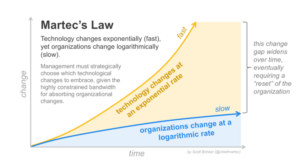
What does that mean for the reentry workforce field? For the most part, it means learning how to strategically weather disruption. We’ve seen wave after wave of labor market changes attributed to AI, yet some organizations have already begun reversing previous decisions and are re-hiring human labor.
The back-and-forth highlights the gap noted in Martec’s Law; the opportunities that exist in the uncertainty between where organizations are and where they could be. To ensure that justice-impacted job seekers are employable now and adaptable to advance with change, it helps to recognize and plan for the long-term possibilities.
Reexamining Need and Reallocating Labor
The challenge for modern job seekers isn’t a shortage of jobs; it’s a mismatch between where workers are and where the opportunities have moved. AI and automation may be eliminating routine task roles, but not roles requiring creativity, mental agility, and an indisputable human touch, like the skilled trades. For justice-impacted job seekers, this shift offers an opening if they can show employers they possess the desired skill set.
That too, is changing for the better. Job search platforms consistently report that employers are focusing less on candidates who can learn a specific process and more on candidates who can adapt quickly once they’re in the role. That means transferable “soft” skills that shorten the learning curve—leadership, communication and active listening, critical thinking and problem-solving, emotional intelligence, teamwork—are becoming the real currency of long-term employability.
In a LinkedIn survey, 90% of employers reported these so-called soft skills (more popularly referred to now as essential or power skills) to be as important as technical skills. Yet most of those same leaders reported difficulty finding hires who meet that need. Many of these skills are not easily learned through training; they’re inherent or accumulated across a variety of experiences.
The task ahead for the reentry workforce field is to not only match job seekers based on interest, experience, and learned skills, but to translate a justice-impacted individual’s lived experience into language employers recognize as valuable. Sustainable employment with opportunities for advancement comes through connecting the full range of your job seeker’s capabilities to a labor market that’s reallocating talent to meet the quickly evolving needs of the future of work.
We invite you to view the recording our webinar: “Future of Work” Career Durability in a Changing Labor Market where you’ll hear from experts on how you can prepare justice-impacted individuals to productively navigate uncertainty for career durability and advancement.
Resources Shared by Our Speakers
Continue exploring the topics discussed during the webinar with these resources shared by our panelists.
Dean Craig – Business Services Director, Willamette Workforce Partnership
Kysha Wright Frazier – President & CEO, Corporation for a Skilled Workforce
- Career & Credential Pathways
- Credential As You Go
- Labor Market and Workforce Development System Toolkit
- Tools for Designing Quality Jobs and Economic Mobility
- Workforce Benchmarking Network
Audrey Mickahail – SVP, Market Strategy & Solutions, Opportunity@Work