join us    |   sign in    |   contact us

Author: Kcrowe

Expanding Fair Chance Hiring in the Volunteer State

I first met Dr. William Arnold, Director of the Tennessee Office of Reentry (TOOR), in 2023 at a second chance convening in Tennessee.  The more I spoke with Dr. Arnold, the more impressed I was by the work his team was doing to connect justice-impacted Tennesseans with skills training opportunities and employment. And I was especially impressed to learn that when Tennessee launched TOOR in 2021, it was intentionally housed within the Tennessee Department of Labor and Workforce Development (TDLWD), recognizing the importance finding meaningful work has on supporting an individual’s reintegration back to their community following incarceration.

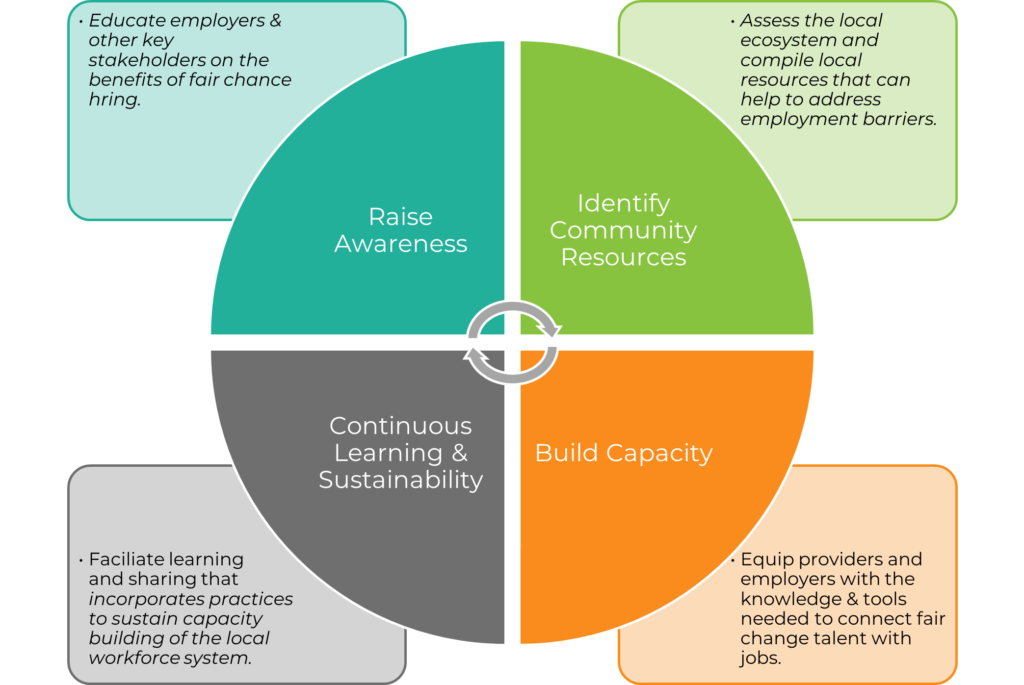
For the past year, the TDLWD TOOR team and NRWC have been partnering to strengthen Tennessee’s reentry workforce ecosystem to expand fair chance hiring statewide. The approach is four tiered. An effective fair chance hiring initiative needs to raise awareness of the benefits of fair chance hiring with employers and the broader community, identify community resources that can be used to address employment barriers, build capacity within the ecosystem to connect the justice-impacted talent pipeline to employment, and support continuous learning & sustainability to promote lasting change.

To support this effort, TDLWD TOOR is building a community of practice (CoP) of dedicated partners connected to reentry workforce efforts across the state. Communities of Practice are “groups of people who share a concern or a passion for something they do and learn how to do it better as they interact regularly”, as defined by Dr. Jeane Lave and Dr. Etienne Wenger.  The shared passion I’ve seen from Dr. Arnold, the TDLWD TOOR team, and their partners in the volunteer state is exactly what’s needed to move fair chance hiring forward and get closer to the vision of economic justice for all community members, criminal record or not.

The NRWC Ecosystem Building Model


Three Common Occupational Licensing Myths

By Caroline Miller & Ronne Hines

Occupational licensing requirements can often seem to prevent a justice-involved job seeker from entering the field of their choice.  The process of applying for a license can be confusing or intimidating. In many cases, job seekers will give up on a dream of entering the career of their choice, when there may have been additional options available to them. Understanding the occupational licensing process, as well as common misconceptions, is critical for effectively navigating occupational licensing barriers. Here are three common myths around obtaining an occupational license for a justice- involved job seeker:

Myth #1: If your application is denied you cannot get a license

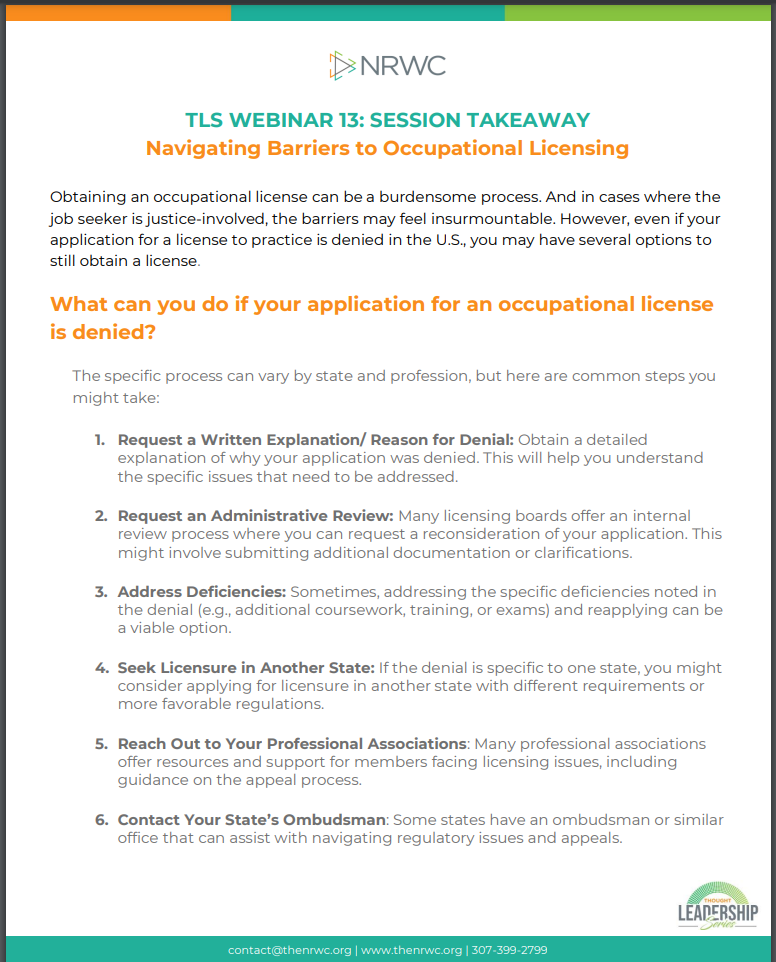
If your application for a license to practice is denied in the U.S., you may have several options to still obtain a license. The specific process can vary by state and profession, but here are common steps you might take:

Request a Written Explanation/ Reason for Denial: Obtain a detailed explanation of why your application was denied. This will help you understand the specific issues that need to be addressed.

Administrative Review: Many licensing boards offer an internal review process where you can request a reconsideration of your application. This might involve submitting additional documentation or clarifications.

Addressing Deficiencies: Sometimes, addressing the specific deficiencies noted in the denial (e.g., additional coursework, training, or exams) and reapplying can be a viable option.

Seeking Licensure in Another State: If the denial is specific to one state, you might consider applying for licensure in another state with different requirements or more favorable regulations.

Support and Resources/ Professional Associations: Many professional associations offer resources and support for members facing licensing issues, including guidance on the appeal process.

State Ombudsman: Some states have an ombudsman or similar office that can assist with navigating regulatory issues and appeals.

Myth #2: There is one path to licensure

State professional and occupational regulation in the U.S. varies significantly by jurisdiction and profession due to differences in state laws, regulatory structures, and the specific requirements for each profession.  These variations reflect the diverse approaches states take to balance public safety, professional standards, and economic opportunities.

State Agencies vs. Independent Boards: Some states regulate professions through state agencies, while others use independent boards. For example, medical professionals might be regulated by a state medical board, whereas cosmetologists might be overseen by a state department of professional regulation.

Legislative vs. Administrative Authority: In some states, licensing requirements are set by state legislatures, while in others, regulatory agencies or boards have the authority to establish these requirements.

Specific Professions: 

Healthcare: Professions like medicine, nursing, and pharmacy are heavily regulated with stringent requirements to ensure public safety.

Trades: Electricians, plumbers, and other trades often have specific state and local licensing requirements that include apprenticeships, experience hours and examinations.

Emerging Fields: Newer professions, such as those in technology or wellness, may have less standardized regulations, leading to greater variability.

Myth #3: Regulations tend to become stricter over time

Occupational and professional regulations can either reduce barriers or add additional regulatory requirements, depending on the approach taken by the state or regulatory body. These regulatory approaches reflect the balance between maintaining high professional standards and making it feasible for individuals to enter and remain in their chosen professions. 

Reducing Barriers:

Reciprocity Agreements: Some states have agreements to recognize licenses from other states, making it easier for professionals to move and work across state lines.   Many states are now focused on mobility and revisiting pathways to achieve this goal.

Streamlined Processes: Simplifying the application and renewal processes can reduce administrative burdens. This might include online applications and automatic renewals.

Lower Fees: Reducing the cost of obtaining and renewing licenses can make it more accessible for individuals to enter certain professions.

Military and Spouse Provisions: Special provisions for military personnel and their spouses can facilitate easier transfer of licenses when relocating.

Apprenticeship Programs: Offering more apprenticeship opportunities can provide practical pathways to licensure without the need for extensive formal education.

Adding Additional Regulatory Requirements:

Increased Education and Training: Some professions require more extensive education and training to ensure high standards of practice and public safety, particularly where the population being served is at risk.

Examinations: Introducing or increasing the scope of licensing exams can ensure that only qualified individuals enter the profession.

Continuing Education: Requiring ongoing education for license renewal ensures that professionals stay current with industry standards and practices.

Background Checks: Implementing background checks as part of the licensing process can add an extra layer of scrutiny to protect public safety.

Specialized Licenses: Creating specialized designations for different areas within a profession can ensure that practitioners have the specific skills needed for their particular field.


Access to quality employment is the foundation for building an equitable economy. While there is still a lot of work to be done on a policy level to ensure states and licensing boards are not excluding individuals unduly from obtaining an occupational license, understanding current processes can help present day job seekers to realize their dreams and entering careers they may have believed out of reach. 


Caroline Miller and Ronne Hines are former regulators and past presidents of the Council for Licensure, Enforcement and Regulation (CLEAR) who currently lead The Regulatory Consulting Group.

 

Philadelphia’s Fair Chance Series and NRWC Employer Engagement Program

This fall, Philadelphia Works in collaboration with JPMorganChase, NRWC, Envoy, and
the Chamber of Commerce of Greater Philadelphia launched the Fair Chance Series
and Employer Engagement Program.

The program will increase economic opportunity for justice-impacted job seekers and
help employers find and support qualified candidates. The program supports fair chance
hiring by providing employers training and resources through Envoy that will allow them
to build more effective partnerships with community-based organizations and diversify
their talent pipelines. Additionally, support is given to providers serving justice-impacted
job seekers to find and engage fair chance friendly employers. To support the latter
goal, NRWC facilitated a two-day Employer Relationship Development Workshop with
17 organizations supporting justice-impacted job seekers in Philadelphia and the
Delaware Valley, and will continue to support providers through the end of 2025 through
a community of practice model.

More information on the launch of the Fair Chance Series and Employer Engagement
Program can be found here: Philadelphia Partners Unite to Expand Career Opportunities for Justice-Impacted Individuals


The Most Valuable Asset of a Company is its People

Over the past few years, we have talked with many practitioners and representatives of
CBOs, state agencies, American Job Centers, chambers of commerce, and other
groups that are involved in fair chance hiring. Often, when we talk about their work
finding job opportunities for justice-impacted job seekers, they say things like,
“employers need to give our people a chance”, or other similar statements. While I
understand the sentiment, we at NRWC believe that the most valuable asset of a
company is its people. Groups involved in fair chance hiring are helping connect
employers with their most valuable asset. When an employee’s skills, aptitude, and
personality line up with the job and the culture of the company they add tremendous
value.

Hiring Justice-Impacted Employees

Maybe that person has a criminal record. And if they do, it doesn’t mean they are any
less likely to be the right person for the job. However, many employers view a justice-
impacted job seeker as a risk. Seeing a criminal record may be taken as an indicator
that a job seeker will be less reliable, will underperform, or may create problems on the
job. An employer may even have experience with a former employee who was justice-
impacted and proved not to be the best fit. But chances are, they likely also have
experience with non-justice impacted employees not being the best fits. When looking
into whether justice-impacted employees were more likely to be fired, a team of
researchers from Northwestern University’s Pritzker School of Law found that not only
were justice-impacted employees no more likely to be fired than non-justice-impacted
employees, but they were less likely to quit – saving their employers a significant
amount in turnover costs.

Additionally, the labor force is contracting. We have all either seen first-hand or heard stories about the difficulties in recruiting and retaining employees over the past several years. The Bureau of Labor Statistics projects that the labor force participation rate will fall to 60.2% in 2032. Before the Covid-19 pandemic, the participation rate was at 63.3% and has generally been decreasing from a 2000 high of 67.4%. Expanding efforts to recruit more hard-working employees is responsible business. Those efforts shouldn’t stop at a criminal record.

NRWC Employer Engagement Training Program

This is a large part of why NRWC launched its Employer Engagement Training program. To equip support organizations (CBOs, Chamber of Commerce, Government Agencies, etc.) with the practices and tools they need to build talent pipelines and long-term relationships with employers, hence, providing their most valuable asset. The program is changing the way people in these organizations think and engage with employers.

Education, Healthcare, and the Justice-Impacted Workforce

Increasing access to education and healthcare are crucial steps towards providing justice-impacted individuals with better economic opportunities. Recent federal policy changes, specifically the reinstatement of Pell Grants for incarcerated students and Medicaid expansion for incarcerated individuals, promise to significantly impact the justice-impacted workforce.

Reinstatement of Pell Grants for Incarcerated Students After a 26-year ban, Pell Grants were reinstated for incarcerated students on July 1, 2023, through the FAFSA Simplification Act. Following the Second Chance Pell Experiment that began in 2015, this federal grant is awarded to undergraduate students with financial need and does not require repayment.

Who is eligible:
All incarcerated individuals, regardless of sentence length or conviction type, are eligible. Approved Prison Education Programs (PEPs) must be reviewed and endorsed by corrections agencies, accrediting bodies, and the U.S. Department of Education. After two years, these programs undergo a best interest determination review to potentially become official PEPs. [Accessing Pell Grants for College Programs in Correctional Settings](https://www.vera.org/publications/accessing-pell-grants-for-college-programs-in-correctional-settings)

How community groups can get involved:
– Support the development of high-quality PEPs
– Improve support for incarcerated and reentering individuals
– Review PEPs for student interest
– Participate in feedback processes to determine PEP continuity

Medicaid Expansion for Incarcerated Individuals Medicaid 1115 Reentry Waivers allow states to expand Medicaid coverage to incarcerated individuals up to 90 days before their release. Over the next two years, new opportunities, including grants and policy changes, will enhance care transitions and system-building.

Who is eligible:
States must apply for these waivers, with approvals already granted to CA, WA, MT, and MA. Nineteen states have pending proposals, and more are expected.

How community groups can get involved:
– Play a larger role in pre-release service delivery
– Increase services through new and strengthened connections

Promoting Economic Advancement for Justice-Impacted Individuals In “Normalizing Opportunity,” JFF’s Center for Justice & Economic Advancement proposed a policy agenda to support the 70 million Americans with criminal records. [Normalizing Opportunity: A Policy Agenda to Promote Economic Advancement for People With Criminal Records](https://www.jff.org/idea/normalizing-opportunity-policy-framework/) Download the Framework

Key areas and policy recommendations include:

1. Education, Skills Training, and Career Navigation

2. Employment and Wealth-Building

3. Mobility Supports

4. Essential Infrastructure

These policy changes and recommendations aim to create a more equitable economic landscape for justice-impacted individuals, helping them build better futures through enhanced education and healthcare access.

SHOW NOTES: Federal Policy Changes

Continue reading

NLC – Bringing Lived Experience To City Hall

Discover firsthand insights from justice-impacted local elected officials during Second Chance Awareness Month.

Join NLC’s Municipal Reentry Leaders Network (MRLN) on April 25, 2024 to hear personal stories of transformation and learn why it’s crucial for returning citizens to engage in local politics.

The MRLN, a collaborative initiative with the John D. and Catherine T. MacArthur Foundation’s Safety and Justice Challenge, offers city leaders resources to enhance reentry programs. Gain access to promising approaches, federal policy updates, and connections with fellow leaders and experts. Join us in shaping inclusive communities where second chances thrive.

This virtual event takes place Thursday, April 25, 2024, 1:00-2:15 PM (EDT).

Register Today!

Three Benefits of Collaboration in Reentry

Individually, we are one drop. Together, we are an ocean – Ryunosuke Satoro

Collaboration is fundamental to the success of most big projects. This is true in reentry as much as it is in any other field with important goals and complex pieces.

Here are three benefits of collaboration in reentry:

1. Problem solving: Working with people who have different areas of expertise and perspectives often results in better ideas and outcomes. A solution you are not seeing could come from another organization approaching it from a different angle.

2. Knowledge sharing and best practices: Through collaboration, you are able to share what you have learned over the time you have invested in the field. Through gathering and sharing that knowledge, as well as developing and validating best practices, collaborators will build resources to better achieve their goals.

3. Innovation: Collaboration provides an opportunity to focus on new and emerging knowledge. Bringing organizations together can not only provide a venue to identify areas of innovation but also to quickly disseminate new ideas and resources.

Pathway to Employment in the Health System

Important Findings from Lifespan’s Justice-Impacted Cohorts

During a recent Thought Leadership session we explored how Lifespan, Rhode Island’s largest employer and healthcare system, developed Pathway to Employment (PTE). This innovative work-based learning program equips individuals affected by the criminal legal system with the skills and connections needed to secure employment in this rapidly expanding industry.

Here are the findings they shared with us:

Thoroughly vet Community Based Organizations (CBO): Clearly define roles
and responsibilities to enhance clarity and ensure alignment with shared
upfront goals. If CBOs are the referral resource, ensure that the candidates are
“ready” for the opportunity, not just in the greatest “need” for the opportunity.
Conduct comprehensive candidate vetting to ensure the participant possesses
a fundamental level of work readiness and motivation aligned with employer
standards, not just CBO standards.

Use Cohorts When Possible: Using cohorts offers chances for collaborative
learning, fostering connections, and establishing internal support systems.

Establish Multiple Touch Points: The structure and engagement of
participants are crucial for success. Maintaining multiple touchpoints at each
stage (recruitment, onboarding, training, post-program) is vital for building
relationships, trust, and ensuring retention.

Set Clear Expectations and Foster Continuous Learning: Establish and
promptly review program expectations, ensuring consistent job coaching
throughout. Be in constant pursuit of learning and improvement. Gathering
participant feedback throughout the process is essential to tailor the program
to the specific.

Use an Employer-Driven Approach to Training & Preparation: Provide
employer-driven work readiness and emotional intelligence training before
and during employment. Frame these sessions with discussions and goal
setting to provide structure and guidance. If employers are not directly
providing the training, they must have input or approve any work readiness
programs.

Establish a Feedback Loop: Ensure transparent communication regarding
compliance and accountability. Implement a formal system to hold
participants accountable. Provide feedback as close to the moment as possible,
including an action plan for improvement or recognition for a job well done.

Assess and Monitor Capacity Periodically: All parties must maintain a realistic
understanding of their capacity, role, and delivery of services. Reentry
workforce programs and participants have high needs, necessitating regular
evaluations of staffing and resources capacity. (This assessment should extend
not only to your organization but to all partners as well.)

Continue reading

The Role of the Federal Government – Tips for Accessing Federal Funding

Each year, the federal government funds reentry initiatives, but accessing these resources can be difficult for stakeholders. NRWC connects stakeholders in the reentry workforce sector, facilitating collaboration with federal agencies.

In our recent Thought Leadership session we explored state and local programs for justice-involved individuals and ways community organizations can partner with the federal government. Joined by Molly Bashay, US DOL Senior Policy Advisor and Rachel Brushett, PH.D. US DOJ Senior Advisor.

View recorded Thought Leadership session.

4 Tips for Accessing Federal Funding to Advance Reentry Workforce Programming

  • Understand the Landscape: Several federal agencies release funding solicitations to support reentry workforce programming, with the Employment and Training Administration (Department of Labor) and The Office of Justice Programs (Department of Justice) administering the largest investments. Get acquainted with current and anticipated funding opportunities through Department websites, as well as The National Reentry Resource Center:
  • Prepare Early: Applying for a federal grant can feel like an overwhelming process. Proposals often require many components and limited time to assemble them. Start preparing early by reviewing Department websites and past years’ solicitations to get a sense of what pieces you’ll need in place. Solicitations may vary year to year, but in many cases, there’ll be enough similarities to give yourself a head start. If an opportunity you’re planning on applying for doesn’t have an anticipated posting date yet, the past year’s solicitation timeline will often give you a ballpark idea of the timeline.
  • Think Partnerships: After identifying an opportunity, get your partners on board early and make efforts to ensure you have the right relationships in place for effective and dependable program delivery. Not having the right partners can set you back in the application process as well as in service delivery once you’re awarded a federal grant. Additionally, you may find a great funding solicitation for your community that you don’t qualify for as the applicant. In those cases, ask yourself whether you have a partner who would qualify and whether it makes sense for your organization to participate as a sub-grantee or another necessary service provider.
  •  Take an Honest Look at Organizational Capacity: No organization wants to make a commitment to their community that they’re not prepared to follow through on. Before applying for a federal grant, assess your internal capacity for any required programmatic, fiscal, and administrative activities. The Uniform Guidance provides an important grant management resource.

Loading...