join us    |   sign in    |   contact us

Author: Kcrowe

Tips for Accessing Federal Funding from a Practitioner’s Perspective

Sharing my experiences as a practitioner who has worked on a federally funded program valued at $5 MIL and whose agency and co-grantees were awarded $4.75 MIL in the past 12 months from the US Department of Labor (DOL) and US Department of Justice (DOJ) respectively. After feeling the sting of federal grant rejection, I am pleased to be able to share lessons learned directly from an NRWC convening that helped us regroup and successfully reapply. 

By Malia K. Salaam, Reentry Program Manager – SER Metro-Detroit, SERCO (Detroit at Work/American Jobs Center provider)

Do your Homework: Become a student of the federal grants process and learn every required element the grant. Finding the right funding opportunity that aligns with your organization’s mission, goals, and capacity is more beneficial than trying to bend your org to fulfill the requirements of the grant. Some of our research included interviewing past winners to gain insight on their application process. Review the types of projects that have recently received awards and identify any gaps that your proposal may fill in your region. Attend government hosted webinars that help prepare you for the specific funding opportunity. You don’t know what you don’t know and these forums are a great place to learn which questions to ask and potentially receive your answers on the spot (or later via email).

Build your A Team: Instead of utilizing one sole grant-writer, identify 3 or more key staff within your organization with whom you can collaboratively author a proposal. This could include an executive leader to work on the administrative components such as establishing your Just Grants (DOJ) or gov, formerly Grants.gov (DOL) accounts. Other teammates divide assignments by strengths, such as the budget, program narrative, and responding to RFP questions. Your grant writer or other designee should review the final document in its entirety to ensure your proposal has ‘one voice.’

Know your Audience: As Andre Bethea (Sr. Policy Advisor, Department of Justice), one of the experts at the 2022 NRWC Conference Federal Funding session told me, DOJ prefers short, concise responses to their application questions. We had applied for the Second Chance Act opportunity in 2022 and not been awarded. It turns out we may have been a little too flowery and long-winded in our responses. Something, the DOL may not mind as long as the verbiage is relevant, but the DOJ does. He commented that in past years, an awardee had even provided responses in bulleted form. While I wouldn’t go that far, I would advise you to structure the tone of the proposal in the language that your prospective funding agency speaks.

Get your Docs in a Row: Whether it be org charts, resumes, business and fiscal documents, MOUs and support letters from partners (especially your corrections partner), you don’t want to leave this task to the last minute. At the outset, be sure to go through the RFP or FOA with a fine-tooth comb and identify every supporting document that must be submitted with your application and determine who from your team is responsible for gathering the document(s) and assign due dates. Having the most outstanding proposal in the world won’t matter if the requisite docs do not accompany it in your submittal. Most agencies use a missing document as a weed-out tool, to narrow the pool of applications they have to review.

Download Resource

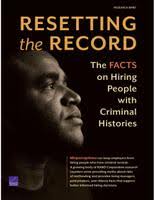
Resetting the Record – The Facts on Hiring People with Criminal Histories

We are pleased to present the latest Research Brief authored by Shawn Bushway, an Adjunct Policy Researcher and Professor of Policy Analysis at the Pardee RAND Graduate School.

RAND Corporation’s Resetting the Record research challenges myths surrounding hiring individuals with criminal records. Providing evidence-based findings to help employers make fact-driven decisions.

“People Change: About 75 Percent of People with a First Conviction Do Not Get a Second Conviction Within Ten Years”

Continue reading

Fair Chance Employer Engagement Training Program

“The best social service is a job.”– Rev. Leon Sullivan, Founder, OIC of America (OICA)

The most powerful and transformative thing we can do is to help a person find a way to provide for themselves and their family.  The opportunity to work is a gift to humanity. Unfortunately, those with a criminal record face insurmountable barriers to job opportunities. – This is why the work of our Community Partners is crucial. 

In a collaborative effort, the NRWC teamed up with the Latino Coalition and 15 fair chance hiring community partners in Denver, CO. The heartfelt objective was to empower our community partners with the essential knowledge, practices, tools, and resources needed to establish trusted and long-term relationships with employers, fostering talent pipelines that enhance employment placement and retention outcomes.

A sincere appreciation to all who set aside their daily commitments to be with us for two days. It meant a lot as we came together to reflect deeply on how our organizations could be more effective at helping justice-impacted job seekers. A special shout out to the CDOC employment and training navigators for your participation. Everyone’s presence and commitment made a significant impact.

 The NRWC creates space to facilitate peer-to-peer learning and the implementation of the 20 leading practices in employer engagement.

  • Ex3 Assessment: Starting with the Employer Engagement Excellence assessment to understand each organization’s level of readiness to engage with employers.
  • Training: Empowering individuals and organizations to implement best practices, our focus includes current trends in Fair Chance Hiring (FCH), employer risk perceptions, the business case for FCH and the five phases of employer engagement with leading practices.
  • Toolkit:  Providing helpful tools and educational resources to enhance understanding in the reentry workforce field. 

What’s next? NRWC will continue our partnership with the LCCL to lead and support the community partners using a community of practice model (CoP). We will facilitate ongoing peer learning and implementation of leading practices. The goal is to help the organizations build long-term relationships with employers and talent pipelines that lead to economic mobility for justice impacted job seekers.

We are looking forward to replicating this approach across the country. If you would like to learn more about our Employer Relationship Development Program, please let us know. Contact@thenrwc.org

Tennessee Accelerates its Fair Chance Hiring Effort with NRWC

In 2021, Tennessee passed two Justice Reinvestment Initiative (JRI) bills – Alternatives to Incarceration Act and the Reentry Success Act into law.

Under the leadership of Governor Bill Lee, some of the funding was used to establish the Tennessee Office of Reentry (TOOR) (a division of the Tennessee Department of Labor and Workforce Development) to assist justice-impacted job seekers overcome barriers to employment and to increase support for employers hiring justice involved individuals.

This pivotal move underscored the state’s commitment to redefining the narrative of reentry and creating opportunities for businesses to benefit from the state’s untapped talent of justice-involved job seekers. Businesses across various industries in Tennessee – from manufacturing to hospitality, and beyond – are embracing Fair Chance Hiring practices.

The NRWC is partnering with the Tennessee Office of Reentry to provide Employer Relationship Development Training. This training will accelerate efforts of the Chambers of Commerce in the four largest urban areas of Tennessee (Chattanooga, Knoxville, Memphis, and Nashville), state agencies and community groups across the state, to effectively engage and build long-term relationships with employers.

The goal is to equip support organizations to build talent pipelines that open quality job opportunities for justice-impacted job seekers and meet the talent needs of the local labor market.


Loading...